What builder-grade paint is, and why it scuffs
"Builder-grade" isn't a product name. It's shorthand for the paint a builder uses to finish a whole community on schedule, usually one wall color in a flat sheen from the foyer to the bonus room. Flat suits the builder: Benjamin Moore's finish guide (opens in a new tab) calls it "more forgiving of flaws," and it's the easiest finish to touch up.
The catch shows up once you live there. Sherwin-Williams' sheen guide (opens in a new tab) says flat paint "can be more challenging to maintain, as it is prone to scuffs and stains." Benjamin Moore cautions against flat in high-traffic areas: stains are harder to lift from low-sheen paint, and repeated rubbing can burnish the wall into shiny spots. That's why the hall from the garage, the stair wall and the area around the kitchen table tend to look tired first.
Even premium flat paint carries the same advice. Benjamin Moore's Regal Select Flat data sheet (opens in a new tab) describes "an elegant flat finish for low traffic areas." The real fix is the right sheen in each room, and our room-by-room sheen recommendations cover that. If you like the no-shine look, a washable matte is the usual compromise.
Why new walls pop and crack in the first year
New houses move as they dry. The Gypsum Association (opens in a new tab) says fastener pops "are largely caused by lumber shrinkage due to initially high moisture content lumber," with loose attachment, warped framing and the wrong fastener length as other causes. Winter heat dries that framing, and screw heads push up under the paint.
The other pattern to watch for is a gap where the ceiling meets an interior wall on the top floor. The Wood Truss Council of America (opens in a new tab) describes these as gaps that "open in the winter and close in the summer." One cause is truss uplift: in winter the bottom chord of each roof truss sits in warm insulation and dries, while the top chord stays in cold attic air, so the truss arches slightly and lifts the ceiling, as the Journal of Light Construction (opens in a new tab) explains. The truss council notes that arching "has not been associated with structural problems such as truss failure."
Northern Virginia's humid summers and heated winters keep that cycle going; framing lumber shrinks and swells "significantly on a seasonal basis," in the truss council's words. If you bought new in Brambleton, Ashburn, Leesburg, South Riding, Bristow, Gainesville or Haymarket, this list may look familiar.
| What you see | Usual cause | Before you paint |
|---|---|---|
| Nail or screw heads pushing up under the paint | Framing lumber drying and shrinking | Wait out the first heating season, re-fasten the board, then fill, spot-prime and paint |
| Hairline cracks along drywall seams, often above doors and windows | Framing shrinking and swelling with the seasons | Tape and feather the crack, prime it, then repaint the whole wall |
| A gap where the ceiling meets an interior wall, wider in winter | Truss uplift or other seasonal framing movement | Raise it with the builder; the fixes the truss council describes are framing details, not more joint compound |
| Cracks that keep growing, doors that start to stick, floors that slope | Possible settlement or framing deflection | Call the builder before any painter; it's a warranty question, not a paint one |
How soon should you repaint a new house?
The Gypsum Association's repair guidance, updated in 2014 (opens in a new tab), gives a useful anchor: pops that show up a month or more into the heating season should wait until the season ends. So wall repairs belong in spring or later, after your first full winter. Paint is a separate decision, with two sound options.
| Consider | Before you move in | After the first heating season |
|---|---|---|
| Rooms | Empty, so prep and painting go faster | Furniture has to be moved and covered |
| Drywall movement | Still ahead; expect a few pops and cracks in the new paint | The first winter's pops and cracks are visible and fixed once, before paint |
| Builder warranty repairs | The builder may patch your new walls in its own flat paint | Builder repairs come first, then your repaint |
| Best fit | You're changing colors anyway, or kids and pets are hard on the busy rooms | You can live with the builder color for now |
A middle path works too: paint the rooms where flat hurts most (kitchen, family room, hallways, stairwells, kids' rooms) before the furniture arrives, and leave bedrooms and ceilings until after the first winter. If you paint early, remember that eggshell and satin don't hide a dab of touch-up paint the way flat does, so a repaired nail pop usually means repainting that wall corner to corner.
Builder touch-up paint or new paint?
Keep the builder's leftover can while builder flat is still on the walls. Benjamin Moore's touch-up advice (opens in a new tab) is to match the sheen, use the same kind of brush or roller as the original coat, and expect flatter finishes to touch up more easily than glossier ones. Once you repaint in a new product or sheen, the old can stops matching, even in the same color. No can at all? Start with matching an existing color from a chip.
Do the builder's warranty walk-through before you paint
Before new paint goes on, find out what your builder will fix and when. Your written warranty should say whether nail pops and drywall cracks are covered, for how long, and who paints the repair. Terms vary, so read your own.
Step 1: Read the drywall and paint terms
Note what counts as a defect, whether repairs are a single visit, and whether the builder repaints the whole wall or just the patch.
Step 2: Keep a running list
Photograph each pop or crack with the date and room. A strip of low-tack painter's tape beside each one speeds up the walk-through.
Step 3: Request the visit in writing
Ask well before the warranty period ends, keep copies, and ask whether repairs can be left sanded and primed instead of spot-painted in builder flat.
Step 4: Repaint after the repairs
With the patches done, new paint goes over whole walls, so the color and sheen read evenly.
Rough or unprimed warranty patches need sanding and primer before the new finish, or they'll show through; our drywall repair crews handle that as part of the repaint.
Colors for open floor plans and two-story rooms
In an open plan, color is a whole-floor decision. Where the kitchen, family room and breakfast area share walls, one continuous color usually looks calmer than three, and any color change belongs at an inside corner or a doorway, not partway across a wall.
In two-story foyers and family rooms, a color can look different near the ceiling than at eye level. Sherwin-Williams' guide to color by room direction (opens in a new tab) describes light reflectance value (LRV) as a 0–100 scale of how much light a color reflects, and it recommends higher-LRV colors and warm undertones for north-facing rooms. Popular light neutrals for one continuous color include Sherwin-Williams Alabaster (SW 7008), Benjamin Moore White Dove (OC-17), Sherwin-Williams Agreeable Gray (SW 7029) and Benjamin Moore Edgecomb Gray (HC-173).
- AlabasterSherwin-Williams · SW 7008
- White DoveBenjamin Moore · OC-17
- Agreeable GraySherwin-Williams · SW 7029
- Edgecomb GrayBenjamin Moore · HC-173
Screen colors are approximations. Confirm every color with a physical sample before you paint.
Screen colors are approximations, so test real samples: a large patch at eye level and a sample board held up from the landing, checked in morning and evening light.
Questions new homeowners ask about repainting
- Can we fill nail pops ourselves before painting?
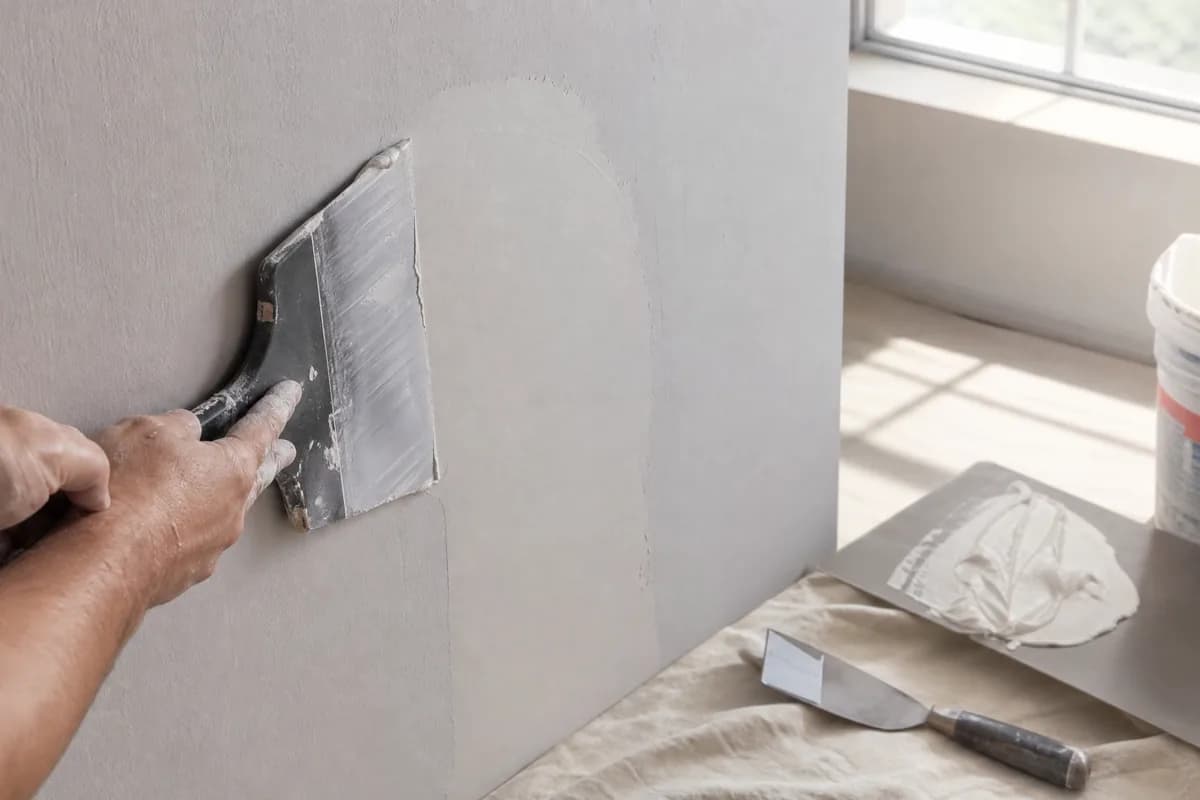
- You can, but filling over a popped head doesn't pull the drywall tight again. The Gypsum Association's repair is to drive a new fastener into the same framing member about 1½ inches from the pop, reset or remove the old one, then finish with joint compound. Do it after the heating season, and if your warranty covers pops, leave them for the builder's visit.
- Should we repaint the ceilings too?
- Not always. Flat is still the usual ceiling finish (Sherwin-Williams lists ceilings under flat), so a clean builder ceiling isn't a problem in itself. Repaint it if it's stained or patched, or if a warmer wall color makes the builder's white look off.
- How soon can we wash newly painted walls?
- Give the paint time to cure before you scrub. Benjamin Moore's Regal Select Flat data sheet, for example, says painted surfaces can be washed after two weeks, and that high humidity and cool temperatures mean longer dry, recoat and service times. Check the data sheet for your product.
A planning checklist for painting a new home
- Find the builder's paint details: product, color name and code, and sheen for walls, ceilings and trim.
- Pick the rooms that can't wait.
- Log nail pops and cracks with photos and dates, and request the builder's walk-through in writing before the one-year mark.
- Fix drywall before paint: re-fasten pops, tape cracks and spot-prime every patch.
- Choose a sheen for each room and test colors with large samples on your own walls.
- Paint empty rooms when you can, before move-in or between furniture deliveries, and keep the leftovers labeled by room.
Or hand us the list. We repair the drywall and repaint new homes across Loudoun and Prince William, with every patch primed and two coats on every wall. Ashburn, Brambleton and Leesburg are served from our Tysons office; South Riding, Bristow, Gainesville and Haymarket from the Manassas team. Start with a free estimate: we walk the house with you, note what needs drywall work before paint, and send a written quote that names the product, color and sheen for every room.
Sources
Rules, dates and product limits in this article come from these pages. Check them again before you start; agencies update their guidance.
- Benjamin Moore — How to Choose a Paint Finish (opens in a new tab) — accessed November 7, 2026
- Sherwin-Williams — How to Choose a Paint Finish (paint sheen guide) (opens in a new tab) — accessed November 7, 2026
- Benjamin Moore — Regal Select Premium Interior Paint & Primer, Flat N547, technical data sheet (2020) (opens in a new tab) — accessed November 7, 2026
- Benjamin Moore — How to Touch Up Paint (opens in a new tab) — accessed November 7, 2026
- Gypsum Association — GA-222-08, Repairing Screw or Nail Pops (copy hosted by InspectAPedia) (opens in a new tab) — accessed November 7, 2026
- Walls & Ceilings — Updated Recommendations for Gypsum Panel Product Repairs (GA-221 and GA-222, 2014) (opens in a new tab) — accessed November 7, 2026
- Wood Truss Council of America — Partition Separation: Prevention and Solutions (2000–01) (opens in a new tab) — accessed November 7, 2026
- Journal of Light Construction — Q&A: Truss Uplift Causes & Cures (opens in a new tab) — accessed November 7, 2026
- Code of Virginia § 55.1-357 (new-home warranties) (opens in a new tab) — accessed November 7, 2026
- Sherwin-Williams — How to Choose Paint Colors Based on Room Direction (opens in a new tab) — accessed November 7, 2026
Talk to Your Local Team
Free walkthrough and a written quote from the office that serves your ZIP code.